

To work out how much concrete you need, the basic formula is simple: multiply the length, width, and depth (or thickness) of the area you’re filling. The key is to make sure all your measurements are in the same unit. Metres are the standard, as this gives you the final volume in cubic metres (m³) – exactly what your supplier will ask for.
Why Accurate Concrete Calculations Are Essential
Getting your concrete volume wrong is a mistake that can derail an entire project. For any groundworks contractor in the UK, mastering this basic calculation is fundamental to running a profitable and efficient site. It’s not just about avoiding waste; it’s about protecting your schedule, budget, and the structural integrity of the build.
Precision is everything here. An inaccurate order can throw a whole day’s schedule into chaos. If you order too little, you suddenly face:
- Costly Delays: Work grinds to a halt while you wait for a top-up delivery. Meanwhile, your labour and hired machinery, like dumpers and excavators, are sitting idle, costing you money.
- Extra Charges: Part-load fees for small top-up deliveries are expensive and can sting your budget.
- Structural Risks: A long delay between pours can create a ‘cold joint’. This weak point in the structure is a serious problem that could compromise its long-term durability.
On the other hand, ordering too much concrete also hits your bottom line. You’re not just paying for material you can’t use, but you’re also stuck with the cost of getting rid of it. In a competitive market, these small errors quickly eat into your profit margins. A professional outfit gets it right the first time.
Getting your sums right from the start is a clear sign of a well-managed project. It shows professionalism and ensures every stage of the groundwork, from excavation to the final pour, runs smoothly and efficiently.
Quick Reference Concrete Calculation Formulas
To help you get started, here is a quick-reference table with the essential formulas for shapes you’ll encounter on site every day.
This table covers the most common scenarios you’ll face. Remember to do all your calculations in metres to get a final volume in cubic metres (m³), the standard unit for UK concrete suppliers. If you need a refresher on the basics, you might find our guide on what groundwork in construction involves useful.
| Shape | Formula (Using Metres) | Example Dimensions |
|---|---|---|
| Square/Rectangular Slab | Length x Width x Depth | 5m x 4m x 0.15m = 3 m³ |
| Circular Column/Post | π (3.14) x Radius² x Height | π x (0.2m)² x 2.4m = 0.30 m³ |
| Trench Footing | Length x Width x Depth | 12m x 0.6m x 0.5m = 3.6 m³ |
This table provides the foundation for almost any volume calculation you’ll need. Next, we’ll look at how to apply these formulas to real-world scenarios, factor in waste, and turn your numbers into a smart, efficient order.
Calculating Volume for Common Concrete Shapes
Now that the basics are covered, it’s time to apply them to the real world. Accurately calculating concrete volume for different shapes is a core skill for any groundworks contractor. Getting it right keeps a project running smoothly.
Let’s walk through some practical examples for the kinds of jobs you’ll see every day across Norfolk and Suffolk.
The key is to break down each task into simple geometry. A shed base is just a rectangle, and a fence post footing is a cylinder. Even a complex foundation can often be split into a series of basic shapes. A common error is failing to convert all measurements to metres before starting the calculation. A small slip-up with millimetres or centimetres can lead to a huge ordering mistake.
This quick visual guide summarises the essential formulas for the most common shapes you will encounter on site.
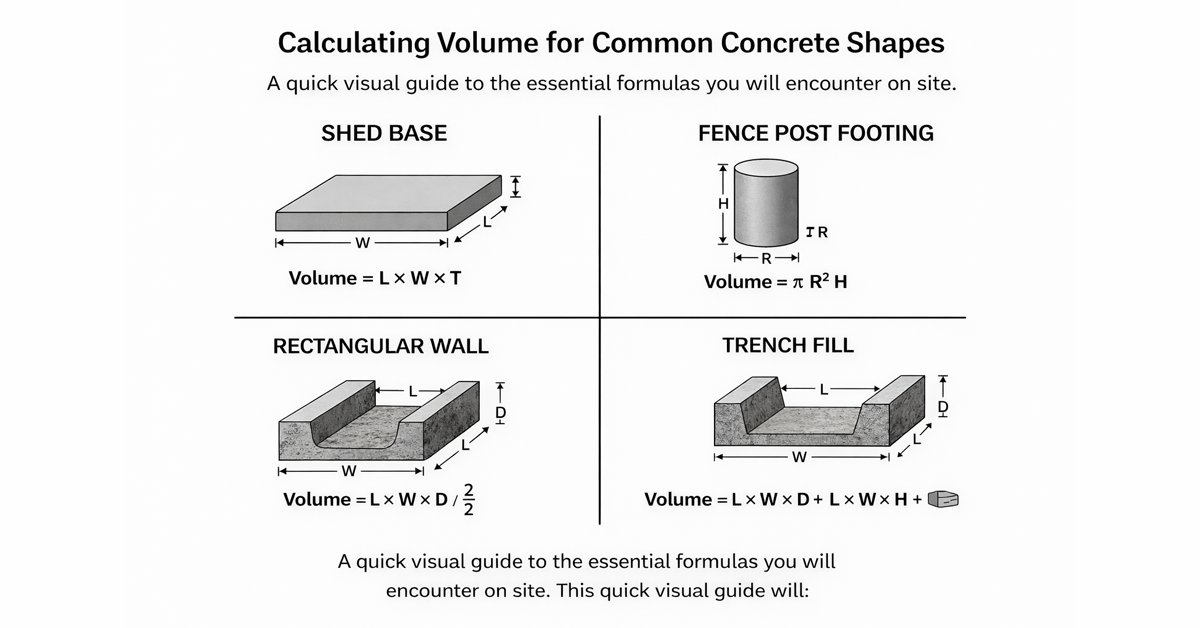
As you can see, whether it’s a slab, column, or footing, a simple formula is all you need to get an accurate volume.
Rectangular Slab for a Shed Base
Let’s start with a straightforward job: a concrete base for a garden shed. This is a simple rectangular slab.
Imagine the client wants a base that is 4 metres long, 3 metres wide, and 150 millimetres deep.
First, get everything into metres. The length and width are already there, but the depth needs changing.
- 150 mm = 0.15 metres
Now, just apply the formula: Length × Width × Depth.
- 4 m × 3 m × 0.15 m = 1.8 m³
For this shed base, you’d need exactly 1.8 cubic metres of concrete. This figure is the starting point for your order.
Cylindrical Volume for Fence Posts
Calculating the volume for cylindrical shapes is just as important, especially for setting posts. The formula might look a bit more complex, but it’s just as easy to use.
The formula is: π × Radius² × Height (or Depth)
Remember, π (Pi) is roughly 3.14, and the radius is simply half the diameter of the hole.
Let’s say you’re installing a gate post and have dug a hole that is 400 mm in diameter and 800 mm deep.
-
Convert to metres:
- Diameter: 400 mm = 0.4 m
- Depth (Height): 800 mm = 0.8 m
-
Calculate the radius:
- Radius = Diameter ÷ 2
- 0.4 m ÷ 2 = 0.2 m
-
Apply the formula:
- 3.14 × (0.2 m × 0.2 m) × 0.8 m
- 3.14 × 0.04 m² × 0.8 m = 0.10 m³
Each post hole requires just over 0.1 cubic metres of concrete. If you have ten identical post holes, you would multiply this by ten (0.10 m³ × 10 = 1.0 m³).
A common mistake is using the full diameter instead of the radius. Always halve the diameter first. This single error can lead to you ordering double the amount of concrete you need for your posts.
L-Shaped Foundations: A Common Challenge
Complex shapes like L-shaped footings can seem tricky. The secret is to divide them into two or more simple rectangles. Calculate the volume for each section separately and then add them together.
Imagine an L-shaped trench footing with these dimensions:
- Long section: 6 metres long
- Short section: 4 metres long
- Width (uniform): 600 mm (0.6 m)
- Depth (uniform): 800 mm (0.8 m)
Method: Split it into two rectangles
You can split the ‘L’ into two rectangular trenches. Let’s call them Rectangle A and Rectangle B.
- Rectangle A (the long part): 6 m (Length) × 0.6 m (Width) × 0.8 m (Depth) = 2.88 m³
- Rectangle B (the short part): To avoid double-counting the corner, subtract the width of the first trench from its length. So, 4 m – 0.6 m = 3.4 m.
- 3.4 m (Length) × 0.6 m (Width) × 0.8 m (Depth) = 1.632 m³
Total Volume:
Now, simply add the two volumes together.
- 2.88 m³ + 1.632 m³ = 4.512 m³
Your total volume for the L-shaped foundation is 4.512 cubic metres. These calculations are crucial, but understanding the right mix is just as important. For more detail, learn about calculating concrete mix ratios to make sure the final product meets your project’s strength requirements.
Turning Your Calculation into a Smart Order
Once you’ve worked out the cubic metres needed, the job isn’t quite done. A precise number on paper is the first step. Turning that calculation into a smart order is what separates a smooth pour from a stressful day on site.
This is where site logistics and professional experience come into play. They bridge the gap between your calculator and the concrete mixer arriving at your gate.

The figure you calculated is the theoretical minimum. In the real world, factors like uneven ground, over-digging, and spillage mean you will always need slightly more. Ordering the exact amount is a rookie mistake that almost guarantees you’ll run short. This leads to costly delays and potential structural issues.
The Professional’s Rule: The 5-10% Contingency
Any experienced groundworker will tell you to add a contingency to your final volume. A professional standard is to add between 5% and 10% to your calculated total. This isn’t guesswork; it’s a safety net that accounts for the realities of a busy construction site.
Think of it this way: for a calculated pour of 5 m³, a 10% contingency means you would order 5.5 m³. That extra half a cubic metre is your insurance against:
- Over-excavation: The ground is rarely perfectly level. Small variations in depth across a large area can consume a surprising amount of concrete.
- Formwork Flex: Timber or steel shuttering can bow slightly under the pressure of wet concrete, increasing the volume required.
- Spillage and Waste: A small amount is always lost during the pour, whether from the chute of the mixer or when moving it across the site.
Ordering slightly more is far cheaper than ordering too little. The cost of a small amount of leftover concrete is minimal compared to the expense of idle labour, machinery waiting for a top-up, and the premium charges for a part-load.
Matching Your Order to the Right Plant and Machinery
Your concrete volume directly influences the machinery you’ll need on site. A small delivery for fence posts might be manageable with wheelbarrows. For anything larger, you need the right plant to move the concrete efficiently from the truck to the pour location.
A volumetric mixer is often an excellent choice, as it mixes the exact amount you need on-site, eliminating waste. But you still need to get that concrete where it needs to go.
- Small Pours (1-3 m³): For a patio base or footing extensions, a 1-tonne skip loading dumper is often perfect. They are nimble enough to navigate tight domestic sites and can quickly transport concrete without manual labour.
- Medium Pours (3-6 m³): For larger foundations or garage floors, a 3-tonne or 6-tonne dumper becomes necessary. These machines can carry a significant volume in each trip, speeding up the pour and ensuring the concrete is placed before it starts to set.
- Large Pours (6+ m³): For substantial commercial slabs, you’ll need a larger 9-tonne dumper or even a telehandler with a bucket attachment. A telehandler offers the advantage of reach, allowing you to place concrete over obstacles or into deep trenches with precision.
To turn your precise volume calculations into a smart order, using tools like modern construction estimating software can improve accuracy and efficiency. This helps ensure your project stays on budget.
Navigating Challenging Market Conditions
Careful planning is more important than ever. The UK concrete industry has faced a significant downturn, with ready-mixed concrete volumes falling to their lowest levels in over sixty years.
Data from the Mineral Products Association showed a drop of 11.5% in a recent quarter, down to just 2.7 million cubic metres. This highlights the challenging market conditions. It’s vital for contractors to be agile and efficient, and for plant hire companies to offer flexible, reliable solutions.
Ultimately, a smart order is about looking beyond the raw numbers. It involves anticipating on-site variables, planning your logistics, and hiring the right machinery to handle the volume efficiently. This forward-thinking approach is what keeps your project on track and protects your bottom line.
Handling Complex Shapes and Site Challenges
Not every job is a perfect rectangle on a flat site. The reality on the ground often throws up challenges that drawings don’t show. That’s where an experienced groundworker’s eye makes all the difference. Learning to adapt your calculations to real-world variables turns a decent estimate into a precise one.
When you’re looking at an irregular footprint or tricky ground, the trick is to break the problem down. Don’t try to calculate a complex shape in one go. Instead, slice it up into a series of simple, familiar shapes like rectangles and triangles. This methodical approach lets you work out the concrete volume accurately, no matter how complicated the layout seems.
It’s all about looking at the plans, spotting the geometric sections, calculating each one on its own, and then adding them all together. Simple.
Breaking Down Complex Foundation Footprints
Let’s say you’re prepping the ground for a house extension with a few angled walls. It might look like a headache to calculate, but it’s manageable if you split it.
A common tactic is to treat the drawing like a grid, dividing the footprint into smaller chunks. You might end up with two or three rectangular areas and a couple of triangular bits where the walls run at an angle. Calculate each one as if it were a separate job.
- Rectangle 1: Length × Width × Depth
- Rectangle 2: Length × Width × Depth
- Triangle 1: (0.5 × Base × Height) × Depth
Add the volumes of these individual shapes, and you’ll have an accurate picture of the total concrete needed. This process stops the costly errors that come from trying to guess the volume of an awkward shape.
Accounting for Slopes and Uneven Ground
Very few sites in Norfolk or Suffolk are perfectly level. A slope is a common challenge that will throw your calculations off if you don’t account for it. If you ignore a slope, you’ll under-order. Guaranteed.
When you’re dealing with a sloped slab, like for a driveway, you just need to work out the average depth.
First, measure the depth at the shallowest point (D1). Next, measure the depth at the deepest point (D2). Then, find the average: (D1 + D2) ÷ 2 = Average Depth. Finally, use this average depth in your standard volume calculation: Length × Width × Average Depth.
For example, a 10m long driveway that’s 0.1m deep at the top and 0.2m deep at the bottom has an average depth of (0.1 + 0.2) ÷ 2 = 0.15m. That simple step makes sure your order is right. Understanding how water will behave on these surfaces is also critical; learn more in our guide on how to install land drainage.
On-site reality always trumps the drawing. Always take your own measurements on the excavated ground before placing a final order. Drawings don’t show soft spots that needed a deeper dig or minor variations that add up across a large area.
Voids and Varying Footing Depths
Other common challenges include voids for pipework or stepped footings. You must subtract these from your total volume to avoid wasting money on concrete you don’t need.
For a void, like a large drainage inspection chamber inside a slab, just calculate its volume (Length × Width × Depth) and subtract it from your main total. Do the same for any areas where services need to pass through the concrete.
For stepped foundations on sloping ground, just treat each section of the footing as its own separate rectangular block. Calculate the volume for each step level, then add them all together. This ensures you’re accounting for the different depths accurately, keeping your material costs under control.
The True Cost of Inaccurate Concrete Orders
In today’s market, every penny counts. When you calculate concrete volume, you’re doing more than just site maths; you’re protecting your project’s profitability and schedule. Getting it wrong has serious consequences that no professional contractor can afford.
A botched order introduces risk and cost that simply shouldn’t be there. These aren’t minor hiccups; they are real hits to your bottom line that can turn a profitable job into a loss-maker.
The Financial Drain of Miscalculation
The most obvious hit from a poor calculation is to your budget. Order too much, and you’ve paid for material you can’t use and will probably have to pay again to have it taken away.
But under-ordering is often where the real financial pain kicks in. The costs spiral fast:
- Labour Downtime: Your entire crew, along with any hired plant like a dumper or telehandler, is left standing around while you arrange a top-up delivery.
- Extra Delivery Fees: Part-load or emergency delivery charges from suppliers are notoriously steep and will blow a hole in your budget.
- Project Delays: Waiting on extra concrete can push your whole timeline back, disrupting other trades and potentially triggering penalty clauses.
These costs are completely avoidable. Careful planning and accurate calculation protect your profit margin and keep the job running smoothly.
Structural Integrity is Non-Negotiable
Beyond the financial sting, getting your order wrong can compromise the structure. If you run short of concrete mid-way, you risk creating a “cold joint”. This happens when the first batch of concrete starts to set before the next delivery arrives.
This creates a weak seam right through the structure. It’s a prime spot for water to get in, and it reduces the overall strength and durability of the slab or foundation. It’s a fundamental mistake that undermines the quality of your work and your professional reputation.
An accurate concrete order isn’t just about saving money; it’s a critical part of professional groundwork. It ensures the final structure meets engineering specs and will stand the test of time, protecting both the client’s investment and your company’s good name.
Looking ahead, the UK concrete market is projected to reach USD 81,742.9 million by 2030, with construction output forecast to grow significantly. For regional plant hire companies and contractors in Norfolk and Suffolk, these figures show that infrastructure projects will keep driving demand. You can find out more about these projections for the UK concrete market. In this climate, a reputation for efficiency, reliability, and precision will win the most profitable work.
Common Questions About Concrete Calculations
Even with the best planning, questions always pop up on site. When it comes to concrete, getting clear answers can save you time, money, and headaches. Here are the straightforward answers to the questions we hear most often from builders and contractors across the UK.
Getting these details right is crucial for a smooth, efficient pour. Let’s clear up some of the most frequent points of confusion.
How Much Extra Concrete Should I Order?
This is a critical question. The answer is simple: always order a little more than you think you need. The professional standard is to add a contingency of 5% to 10% to your final calculated volume.
So, for a calculated pour of 8 cubic metres, a 5% contingency means ordering 8.4 m³, while a 10% top-up would be 8.8 m³. Think of this extra concrete as your on-site insurance policy. It covers the little things that can catch you out, like:
- Slight dips in the sub-base that eat up more concrete than expected.
- The natural bowing of shuttering under the weight of the pour.
- Minor spills while you’re moving it into the formwork.
- The concrete that gets left behind in the mixer’s chute.
Under-ordering is one of the most expensive mistakes you can make. The cost of a small amount of waste concrete is tiny compared to the fees for an emergency part-load delivery and the expense of a crew and machinery standing idle.
What Is The Difference Between Volumetric and Ready-Mix Concrete?
Choosing the right type of delivery can make a huge difference to your project’s efficiency and budget. The two main options, volumetric and ready-mix, suit different scenarios.
Ready-Mix Concrete
This is the traditional method. Concrete is batched to a specific recipe at a plant and delivered to your site in a barrel mixer truck. You have to order a precise quantity. It’s ideal for large, straightforward pours where you are very confident in your volume calculations.
Volumetric Concrete
A volumetric mixer is a mobile batching plant on wheels. It carries all the raw materials—cement, sand, aggregate, and water—in separate compartments. The concrete is then mixed on-site to the exact amount you require. This offers incredible flexibility, making it perfect for:
- Projects with multiple small, separate pours.
- Jobs where the final volume is uncertain due to tricky ground conditions.
- Sites with awkward access where a large ready-mix truck might struggle.
Best of all, with a volumetric mixer, you only pay for what you use. This completely eliminates the risk of over-ordering and waste.
Do I Need to Account for Rebar When Calculating Volume?
For most groundwork projects, the short answer is no. You don’t need to subtract the volume of steel reinforcement (rebar or mesh) from your total concrete calculation.
While the steel does displace a small amount of concrete, its volume is almost always negligible. In a typical reinforced slab, rebar usually takes up less than 1-2% of the total volume. This tiny amount is easily covered by the standard 5-10% contingency you should already be adding for waste and other site variables.
Focus your energy on getting your formwork measurements spot on and factoring in a sensible contingency. That’s a much more important part of getting your concrete order right.
Whether you need a nimble mini dumper for a small domestic job or a powerful telehandler for a large commercial pour, having the right equipment on-site is key to a successful project. Aylsham Plant Solutions provides a modern, reliable fleet of plant and machinery to contractors across Norfolk and Suffolk. Get in touch with our team today to discuss your project needs.
Related Posts