
An excavator attachment isn’t just an add-on; it turns a powerful digging machine into the ultimate multi-tool for any construction site. Think of your excavator as the handle of a Swiss Army knife. The attachments are the blades, screwdrivers, and saws—each designed for a specific job.
Choosing the right attachment from the start is vital for keeping your project on schedule and on budget.
Unlock Your Excavator’s True Potential
An excavator with only a digging bucket is like a carpenter with just a hammer. It’s useful for one thing but limited otherwise. The real power of modern plant and machinery lies in its adaptability. By simply swapping the tool at the end of the boom, one machine can dig, break, grab, drill, and compact.
For projects across Norfolk and Suffolk, this versatility saves money. Instead of bringing multiple machines to a site, a single excavator with the right attachments can handle most tasks.
The Role of Attachments in Modern Groundworks
The right attachments help you get jobs done faster, more accurately, and with less manual labour. Imagine breaking up an old concrete slab with a standard digging bucket. It would be slow, awkward, and likely damage the bucket. Now, picture the same job with a hydraulic breaker. The task is finished in a fraction of the time. This simple principle applies across many on-site tasks.
The core benefit is simple: you get more work done with less equipment and fewer people. This boosts productivity and makes the site safer by reducing manual handling and unnecessary machine movements.
This guide will walk you through the essential attachments you are likely to need. We will explain how each one can solve specific challenges on your job site. We will cover the most common tools, including:
- Digging and Grading Buckets: The basic tools for any earthmoving job.
- Hydraulic Breakers: Essential for demolition and breaking hard ground.
- Selector Grapples: Perfect for sorting demolition waste or handling awkward materials like timber.
- Specialised Attachments: Tools like augers for drilling post holes and rippers for breaking up tough, compacted earth.
By understanding what each attachment does, you can make smarter choices when hiring equipment. This knowledge ensures you always have the right tool for the job, helping you deliver high-quality work on time and on budget.
The Most Common Attachments and Their Uses
Choosing the right attachment turns a good excavator into a great one. It is the key to unlocking its true value on site. It transforms the machine from a simple digger into a multi-purpose workhorse. This guide shows you how these tools perform on real-world job sites across Norfolk and Suffolk, solving specific problems and saving you time and money.
An excavator’s power comes from its ability to switch between a few key jobs. The image below shows the three main roles these machines play on nearly every project.

This shows how a single machine can move seamlessly between digging, breaking, and clearing—all thanks to having the right attachment ready to go.
To give you a clearer picture, this table breaks down the most common attachments and what they are best used for.
Common Excavator Attachments and Their Primary Applications
| Attachment Type | Primary Use Case | Ideal Project Type |
|---|---|---|
| Digging Bucket | Bulk earthmoving, trenching, breaking ground | New housing developments, utility installations, general groundworks |
| Grading Bucket | Levelling ground, finishing batters, creating smooth surfaces | Landscaping, roadworks, final site preparation |
| Riddle Bucket | Screening and separating materials (e.g., soil from stone) | Site clearance, recycling on-site, agricultural drainage |
| Hydraulic Breaker | Demolishing concrete, breaking rock or hard ground | Demolition projects, foundation removal, quarry work |
| Selector Grapple | Sorting waste, handling awkward materials like timber or scrap | Demolition sites, waste transfer stations, forestry clearance |
| Auger | Drilling precise holes for posts, piles, or planting | Fencing contracts, foundation piling, landscaping projects |
| Ripper | Tearing up compacted, frozen, or very hard ground | Initial site prep on tough ground, road construction, agricultural land reclamation |
This table is a great starting point, but let’s look at what makes each of these attachments so vital on a busy construction site.
Digging and Grading Buckets: The Site Workhorses
Buckets are the most basic attachment for any excavator. They are the go-to tool for moving earth, digging trenches, and most general digging tasks. But not all buckets are the same, and picking the right one is key to working efficiently.
Across the UK construction scene, attachments are essential for productivity. This is especially true here in Norfolk and Suffolk, where groundworks are a constant. Industry research shows that buckets dominate the market, holding a massive 43.12% share of all construction machinery attachments. They are the top choice for everything from excavation to material handling. This figure highlights how vital they are, with demand staying strong for infrastructure renewals. You can read the full research about the construction machinery attachment market for a deeper dive.
Common Bucket Types and Their Applications:
- Digging Buckets: These are your standard, heavy-duty buckets with teeth. They are designed for breaking into undisturbed ground and shifting large volumes of soil, clay, or aggregate.
- Grading (or Ditching) Buckets: Wider and toothless, these give you a smooth, clean finish. They are perfect for grading slopes, levelling ground, or finishing drainage channels.
- Riddle (or Skeleton) Buckets: These have gaps or bars that let fine material like soil fall through, keeping the larger stones and debris. They are ideal for screening soil, saving you from having to haul material off-site.
Hydraulic Breakers: For Demolition and Tough Ground
When you hit solid rock or reinforced concrete, the hydraulic breaker is your best friend. Often called a “pecker,” this powerful tool uses hydraulic force to deliver rapid, high-impact blows. It makes short work of tough materials.
A hydraulic breaker can demolish old farm buildings or smash up old concrete foundations before new groundworks begin. The time it saves compared to other methods is huge.
A breaker turns an excavator into a precision demolition tool. It lets operators break down structures piece by piece, giving them far more control than a wrecking ball.
Selector Grapples: For Sorting and Handling
On any demolition or site clearance job, efficiency often comes down to how well you can sort your materials. Selector grapples, also known as sorting grabs, were designed for this task. With two powerful jaws, they can pick, sort, and handle a huge range of materials with surprising accuracy.
They are invaluable for separating waste streams on-site. Wood, metal, and concrete rubble can all be piled separately. This makes waste management far simpler and can cut your disposal costs by making recycling easier.
Typical Uses for a Selector Grapple:
- Waste Sorting: Separating different materials at demolition sites for recycling.
- Material Handling: Moving awkward items like logs, scrap metal, or large rocks.
- Light Demolition: Carefully dismantling structures like timber frames where you need total control.
Augers: For Precision Drilling
When your project needs perfectly circular holes for fence posts or foundations, an auger is the only tool for the job. It is a giant drill bit powered by the excavator’s hydraulics. It can bore into the ground quickly and cleanly.
This attachment is far more efficient than digging by hand, especially when you need dozens of holes. Different bit sizes and types are available to match the ground conditions and hole diameter you need.
Rippers: For Breaking Up Difficult Ground
A ripper is a simple but very effective tool. It is built for one job: to break through extremely hard, compacted, or frozen ground. It is just a single, tough shank with a hardened tooth on the tip.
Instead of trying to scoop resistant material with a bucket, a ripper focuses all the excavator’s power onto one point. This lets it tear through surfaces that would stop a bucket in its tracks. It is an essential first-pass tool before you can start digging in difficult soils.
Matching Attachments to Your Excavator and Project
Getting the right fit between your excavator and its attachment is vital for a safe and productive site. Think of it like trying to fit the wrong size drill bit into a power drill. At best, it will not work properly. At worst, you could damage equipment and create a serious safety hazard.
This section explains the technical side of compatibility. Once you understand the basics, you will know what questions to ask when hiring machinery. It ensures the equipment you get for your Norfolk or Suffolk project works perfectly from day one.
Understanding the Key Technical Requirements
Before any attachment is connected, a few key numbers must align between the machine and the tool. If they do not, you risk poor performance, damage to the hydraulic system, or even a serious failure on site.
The three main pillars of compatibility are:
- Excavator Weight: The machine’s operating weight determines the maximum size and weight of the attachment it can safely handle. An attachment that is too heavy can make the machine dangerously unstable, increasing the risk of it tipping over.
- Hydraulic Flow (Litres per Minute): This is how much hydraulic oil the excavator can pump in a given time. Power-hungry attachments like breakers and augers need a specific flow rate to work properly. Too little flow and the tool will be sluggish; too much can damage its internal parts.
- Hydraulic Pressure (Bar or PSI): This is the force of the hydraulic oil. Like the flow rate, every attachment is designed to work within a specific pressure range. The wrong pressure leads to poor performance or can damage the attachment’s seals and motors.
The golden rule is simple: always match the attachment’s requirements to the excavator’s specifications. A reputable hire company will sort this for you, but knowing what to look for helps you confirm you are getting a safe setup.
The Role of Couplers in Attachment Swapping
In the past, changing attachments was a slow, manual job. It involved sledgehammers and brute force to knock out pins. Thankfully, modern coupling systems have made it a much faster and safer process, reducing downtime on site. Understanding the different types is key to getting the most out of your machine.
There are two main categories you will find.
1. Manual Pin-Grabbers
This is the most basic type of coupler. The operator still has to get out of the cab to manually insert a safety pin to lock the attachment. While it works, it is a manual step that can be a safety risk if not done correctly every time.
2. Hydraulic Quick Couplers
These are standard on most modern hire fleets for a reason. They allow the operator to change attachments in seconds without leaving the cab. The coupler uses the excavator’s own hydraulics to lock and unlock the attachment securely.
Quick Couplers: The Key to On-Site Flexibility
The benefits of a hydraulic quick coupler are huge, especially on projects with multiple tasks. Imagine a typical site preparation job. You need to break up an old concrete base, dig a trench, and then grade the area.
Without a quick coupler, changing from a breaker to a digging bucket and then to a grading bucket could take a lot of time. With a hydraulic coupler, the whole process takes just a few minutes. This is a massive productivity gain that saves time and money.
These systems also make the site a much safer place. By keeping the operator in the cab, you remove the risks of working around heavy, moving machinery. Modern systems also have multiple safety locks to prevent an attachment from being accidentally released. Before you start your next project, it is worth checking our detailed guides on how to find the right excavator hire near me to ensure you get a machine equipped for maximum efficiency.
Specialised Attachments for Advanced Tasks
When standard tools are not enough, specialised excavator attachments step in. They solve tricky on-site problems and unlock new levels of productivity. These are the advanced tools in your excavator’s kit, designed for specific, challenging jobs. They can save you from needing more machinery, manual labour, or time.
Think of them as a smart investment. The right attachment often replaces the need for an entire machine or a separate work crew. This makes them a wise choice for forward-thinking contractors. The focus here is on turning your excavator into a precision instrument for advanced tasks in Norfolk and Suffolk.
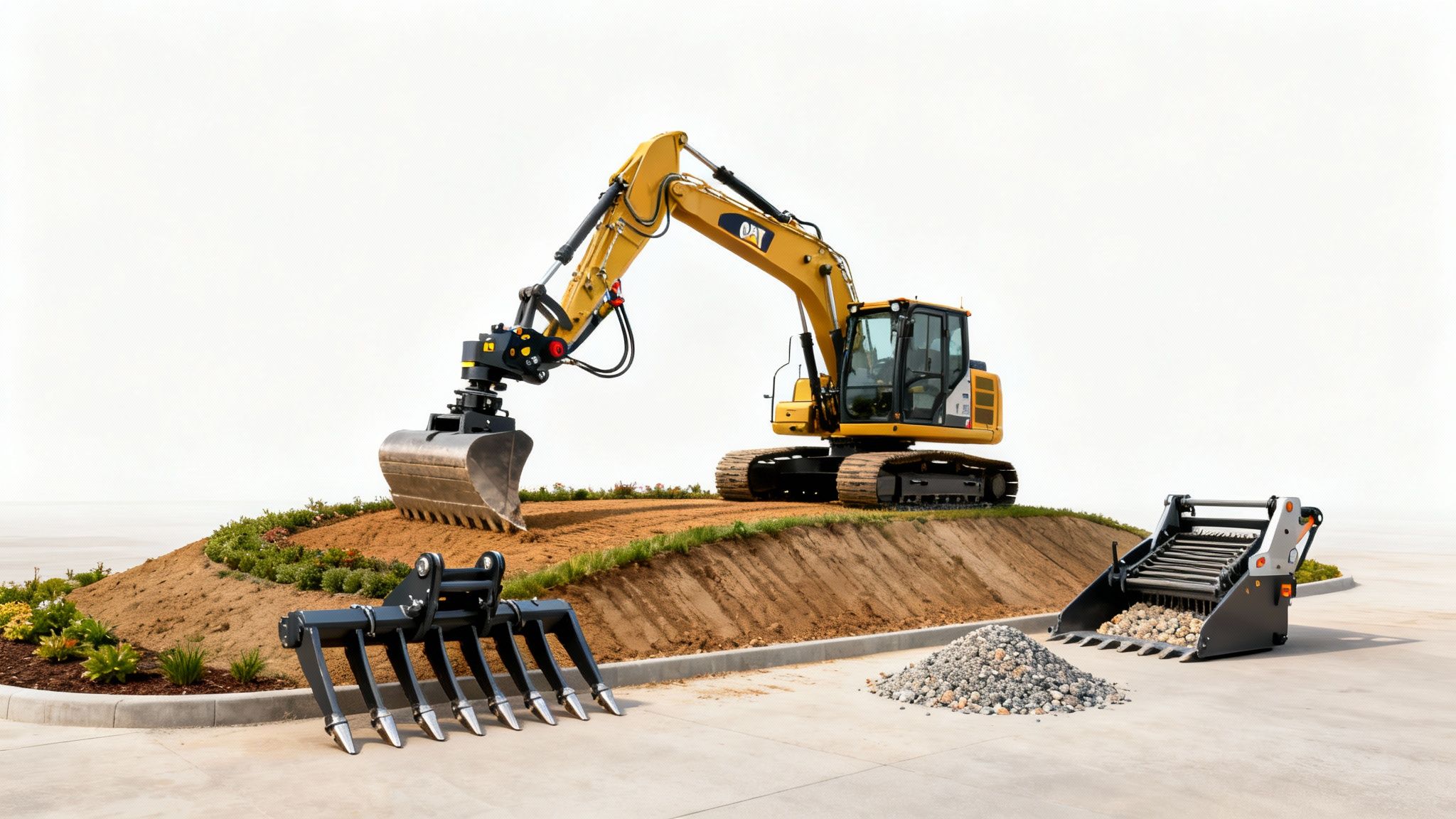
Introducing the Game-Changing Tiltrotator
If one specialised attachment is a true game-changer, it is the tiltrotator. It sits between the excavator arm and your tool. It allows the tool to both tilt up to 45 degrees and rotate a full 360 degrees. This level of control is truly transformative.
Imagine sculpting a complex drainage channel. Without a tiltrotator, the operator must constantly reposition the entire excavator to get the right angle. With one, the machine can stay still while the attachment does all the work with wrist-like dexterity.
Industry experts estimate that an experienced operator using a tiltrotator can boost productivity by 20% to 35%. This is because it reduces machine movement, saving fuel and wear. It also allows for more precise, faster work in tight spots.
Ripper Teeth for Unforgiving Ground
We have all been there—you hit a patch of ground that a standard digging bucket cannot get through. It could be heavily compacted sub-base or rocky terrain. This is where the ripper tooth proves its worth.
A ripper is a single, heavily reinforced shank that focuses all the excavator’s power onto one small point. It acts like a giant claw, tearing through stubborn ground. It loosens the material so a digging bucket can come in and clear it easily. It is an essential tool for breaking up tough surfaces without the noise of a breaker.
Screening Buckets for On-Site Recycling
In today’s construction world, waste management is a major cost. Hauling excavated material to landfill is expensive, and so is buying new aggregate. The screening bucket (or riddle bucket) offers a brilliant solution. It lets you recycle materials directly on-site.
This attachment scoops up mixed material—like soil, rubble, and stone. It then spins or shakes to separate the fine material from the coarse. This simple process allows you to:
- Create reusable aggregate: The separated stones and rubble can be used for backfill or sub-base.
- Produce screened topsoil: The finer soil is perfect for landscaping and finishing works.
- Cut disposal costs: By reducing the amount of waste leaving the site, you make huge savings on haulage and tip fees.
For any project, the ability to turn waste into a valuable resource is a massive financial win. While these specialised attachments might seem like an added expense, their ability to save time, labour, and materials makes them a highly profitable investment. Their versatility is also key, especially when considering different machine types; learn more about how attachments can be paired with an excavator with wheels for even greater on-site mobility.
Deciding Between Hiring and Buying Attachments
For any contractor in Norfolk or Suffolk, the hire-versus-buy debate for excavator attachments is a constant puzzle. Getting this decision right directly impacts your cash flow, job profitability, and flexibility on site. There is no single right answer. However, by looking closely at how you work, you can create a strategy that makes perfect financial sense.
It all boils down to one simple factor: frequency of use. For the everyday tools you cannot live without, ownership eventually pays for itself. But for everything else, the advantages of hiring are too good to ignore.
The Strong Case for Hiring Attachments
Hiring offers a smart, flexible way to equip your projects. This is particularly true when you need a specialised tool for a specific task. For most firms, it strikes the best balance between capability and cost control.
The financial benefits are immediate. Hiring avoids the large upfront purchase price. This frees up capital you can use elsewhere in the business. This is a game-changer for expensive, specialist kit that might only be needed for one phase of a project.
Beyond that, hiring removes the long-term headaches of ownership. You no longer have to worry about:
- Maintenance and Repairs: The hire company handles all servicing and breakdowns. That means no unexpected bills and less downtime for your team.
- Storage and Security: You do not need valuable yard space to store attachments, nor the stress of keeping them secure from theft.
- Depreciation: Plant machinery is a depreciating asset. Hiring lets you avoid that loss in value from day one.
By hiring, you get access to the latest, most efficient technology for every job without the capital outlay. It means you can pick the perfect tool for a specific task, use it, and then simply hand it back.
When Buying an Attachment Makes Sense
While hiring is often the smarter financial move, there are times when buying an attachment is the right call. Ownership becomes a sensible investment when a particular tool is a core part of your daily operations.
The most obvious example is a standard digging bucket. If your business is built on groundworks, you will use one all day, every day. In a high-use case like this, the cost of repeatedly hiring the same item will eventually be more than its purchase price. This makes ownership the clear winner.
Making the Right Financial Decision
To make a sound choice, you need to be honest about your workload and how you use your machinery. Start by asking a few key questions about any attachment you are considering:
- How many hours will I use it over the next year? Is it for a one-off job or a consistent, daily task?
- Do I have the space to store and maintain it properly? Do not forget the hidden costs of secure storage and regular servicing.
- Will owning it give me a competitive edge? Sometimes, having a specific tool ready to go can help you win more work.
- Can my cash flow handle the purchase price and ongoing costs? Compare this honestly to the simple, predictable cost of hiring.
For most contractors, a hybrid approach works best. Own the essential, high-use attachments like your main digging buckets. Hire the specialised, less frequent tools as and when you need them. This strategy gives you the best of both worlds—cost-efficiency for your daily grind and access to advanced capabilities without the burdens of ownership.
Essential Safety and Maintenance Best Practices
A productive site is a safe site. When dealing with powerful excavator attachments, safety and maintenance must be part of the daily routine. Following the right procedures prevents accidents, protects your operators, and keeps the machinery performing reliably. This ensures your project in Norfolk or Suffolk stays on track.
It all comes down to diligent daily checks before the engine starts. These are not just box-ticking exercises. They are vital routines designed to catch small issues before they become major failures. A few minutes of inspection can save you hours of downtime and prevent a serious incident.
Your Daily Pre-Start Inspection
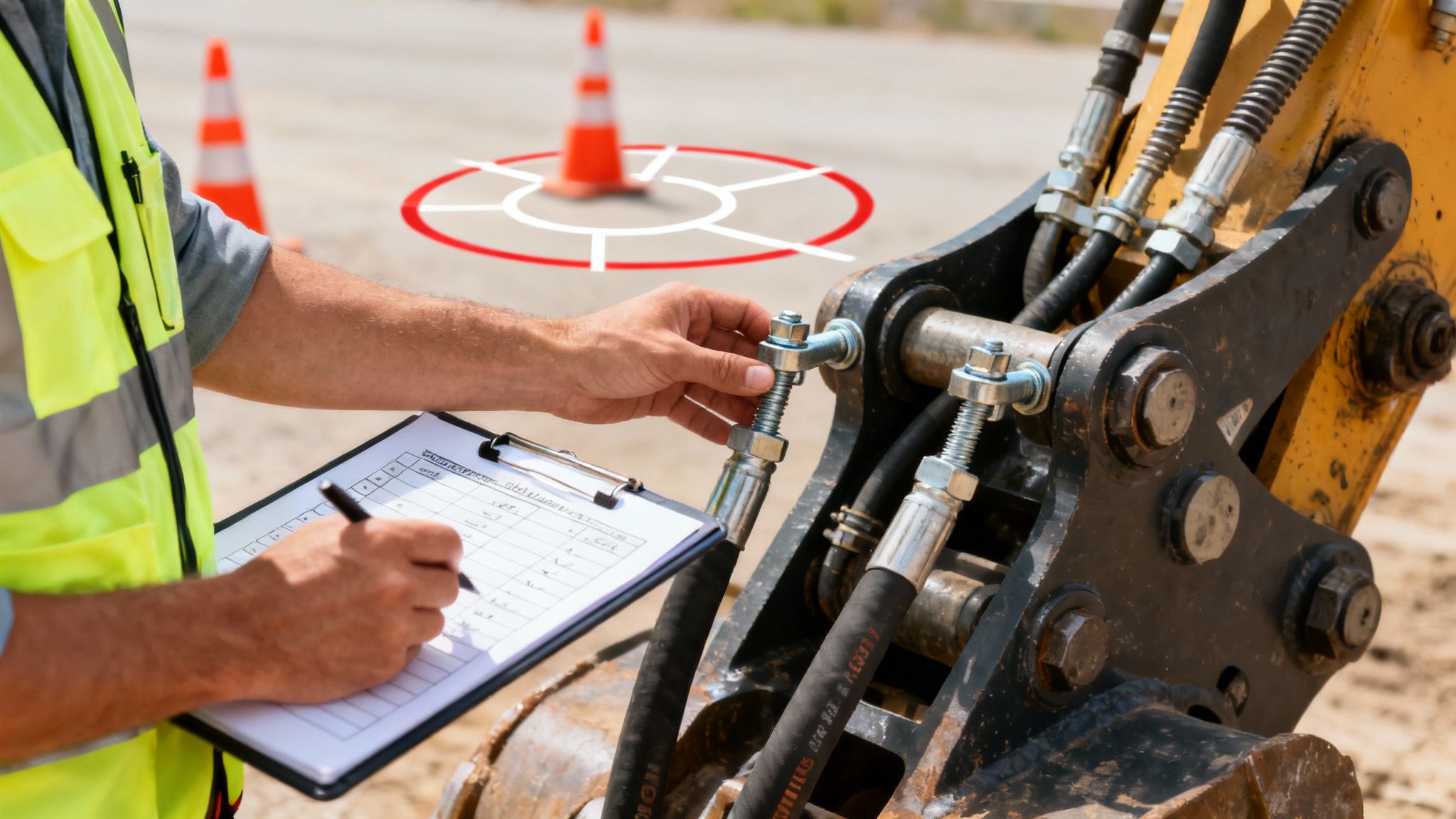
Before anyone gets in the cab, the operator must do a thorough walk-around. They should pay close attention to the attachment itself. Think of this visual check as your first line of defence against mechanical failure.
Your daily checklist must include:
- Hydraulic Hoses: Look for any signs of cracking, bulging, or leaking fluid. A burst hose under pressure is very dangerous and can stop work instantly.
- Quick Coupler Engagement: Do not just assume it is locked. Physically check that the locking pins are fully engaged and secure. A visual check is essential.
- Structural Integrity: Look for stress fractures, deep cracks, or excessive wear on the attachment’s main body, teeth, or cutting edges.
These simple steps are fundamental. To get ahead of potential hazards, it is also smart to embed proper risk assessment methods into your daily planning on site.
Safe Operating Procedures
Once the machine is running, safe operation is everything. Adding a heavy, powerful attachment like a breaker or a grapple changes the excavator’s centre of gravity and handling.
Be constantly aware of how the attachment’s weight affects your stability, especially on slopes or uneven ground. You also need to maintain a clear swing radius at all times to avoid collisions with people, buildings, or other plant machinery on site.
A core principle of safe operation is smoothness. Avoid sudden, jerky movements. That kind of action puts immense stress on both the excavator and the attachment, increasing the risk of mechanical failure.
The Importance of Professional Maintenance
Ultimately, the best way to guarantee safety is to start with machinery that has been professionally maintained. When you hire from a reputable supplier, you get attachments that are fully certified and regularly serviced by experts. It takes all the guesswork out of the equation.
A professional hire company ensures every piece of equipment meets strict safety standards. This oversight is invaluable. And if an issue does crop up, you need to know you have reliable backup. Find out more about our dedicated maintenance and breakdown support assistance to see how we help keep your projects moving safely and efficiently.
A Few Common Questions About Excavator Attachments
Choosing the right attachments can feel complex, especially when you are trying to match the right tool to the job on a busy site. We get asked many questions by contractors across Norfolk and Suffolk, so here are some straightforward answers to the most common ones.
Getting this right from the start means the machine you hire will be safe, efficient, and perfectly suited to your planned work.
How Do I Know Which Size Attachment My Excavator Needs?
The simple answer is that it all comes down to the machine’s operating weight and hydraulic setup. An attachment that is too big for the excavator will make it unstable. One that is too small will be inefficient and could damage the tool.
The best way to get it right is to talk to your plant hire provider. We handle this for you, ensuring the attachment is perfectly paired with the excavator you are hiring. It is also good practice to check the manufacturer’s specifications for both the machine and the attachment to confirm they are compatible.
What Is a Quick Coupler and Do I Need One?
A quick coupler (or quick hitch) is a game-changer on site. It is a device fitted to the excavator’s arm that lets you swap between attachments quickly and safely. You do not have to manually knock pins in and out. If your day involves digging a trench, breaking concrete, and then moving debris, a quick coupler is essential.
It hugely boosts productivity by cutting downtime between tasks. Most modern excavators in our hire fleet, from large machines to mini diggers, come fitted with a quick coupler as standard.
Can I Use Any Attachment on a Mini Excavator?
Definitely not. Attachments are built for specific excavator weight classes. Mini diggers need tools that are scaled for their smaller size and lower hydraulic power.
Putting an attachment that is too heavy on a mini excavator is a major safety risk. It can easily make the machine top-heavy and cause it to tip over, especially on uneven ground.
We stock a full range of attachments designed specifically for our mini excavator fleet, from compact breakers and augers to specialist micro-trenching buckets.
For expert advice on choosing the right attachments for your excavator, or to get a competitive quote for your next project in Norfolk or Suffolk, get in touch with Aylsham Plant Solutions. You can also explore our full range of plant hire options on our website.
Related Posts