
A telehandler is one of the most versatile machines on any construction site or farm in the UK. Its true strength, however, is unlocked by the attachments you fit to its boom. Think of the machine as a powerful, multi-purpose handle. The attachment is the specific tool for the job, turning a simple lifter into a specialised workhorse.
Unlocking Your Telehandler’s True Potential
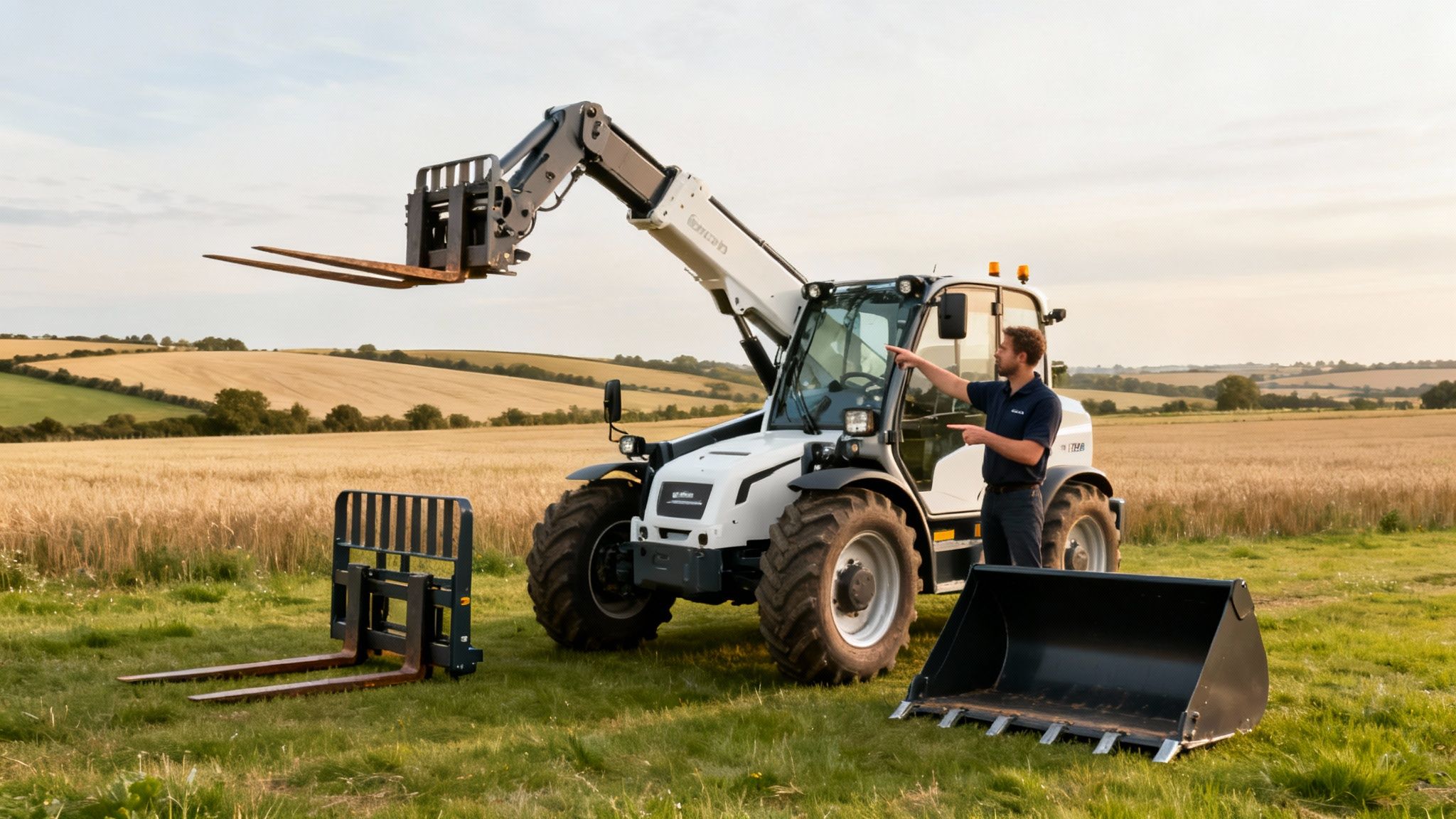
A telehandler without the right attachment is like a skilled tradesperson with an empty toolbox. The base machine offers incredible reach and rough-terrain capability. But it’s the selection of attachments for telehandlers that truly defines what it can do on your site. This guide helps you make a smart choice and turn your machine into an asset that drives productivity.
For contractors in Norfolk and Suffolk, understanding this versatility is key. One day, your telehandler might lift pallets of bricks onto a scaffold with a fork attachment. The next, it could be clearing site debris with a grapple bucket or placing roof trusses with a lifting jib.
Why The Right Attachment Matters
Choosing the correct tool for a task is more than just convenient. It’s a critical decision that affects your efficiency, safety, and project’s bottom line. Using an unsuitable attachment can cause delays, damage materials, or create dangerous situations on site.
Get it right, and the job gets done faster and more accurately. That means less wasted time, fewer machines needed on site, and a smoother workflow. A well-chosen attachment allows one machine to do the work of several, a huge advantage for any busy project.
The core idea is simple: match the tool to the job. By swapping attachments, a single telehandler can perform a huge range of tasks, from handling bulk materials to placing items at height with precision.
This guide will walk you through the most common attachments available. We’ll help you understand their functions and best uses. We will cover:
- The essential attachments every site should consider.
- How to select an attachment based on your project’s needs.
- Crucial safety and maintenance checks to keep your operation running smoothly.
By the end, you’ll have the knowledge to confidently choose the right attachments for your next job. This ensures you get the most from your plant hire and keep your projects across East Anglia moving forward. You can learn more about our range of highly capable telehandlers and find the right base machine for your needs.
The Essential Toolkit of Telehandler Attachments
Attachments are not optional extras. For telehandlers, they are what turn a good machine into an indispensable one. Think of them less as accessories and more as a complete toolkit. Each attachment is a specialist tool designed for a particular job, transforming your telehandler into whatever the site needs it to be.
Let’s look beyond a simple list to get a real feel for what each attachment does best, using examples from sites in Norfolk and Suffolk. This way, you’ll know exactly which tool to grab for your next job.
Forks: The Unrivalled Workhorse
Standard pallet forks are the first thing most people picture on a telehandler, and for good reason. They are the champions of material handling, essential for lifting palletised goods like bricks, blocks, timber, and bags of cement.
Their genius lies in their simplicity. On a new housing development in Norwich, for instance, a telehandler with forks can spend its day unloading lorries and distributing materials to different plots. It can easily reach the second or third storey. This one job is vital for keeping a site supplied and running on schedule.
Buckets: For Bulk Material Handling
When you need to move loose materials, forks are no use. This is where a general-purpose bucket comes into its own. It transforms your telehandler into a powerful, rough-terrain loading shovel. It’s perfect for shifting bulk loads of soil, sand, aggregate, or site waste.
Imagine you’re prepping a site in rural Suffolk. A telehandler with a bucket can quickly load spoil into a dumper, move gravel for a new driveway, or clear away debris after demolition. Their robust design means they can handle heavy, abrasive materials day in and day out.
A bucket broadens a telehandler’s role from just lifting to active site management. It becomes a machine that can both build up and clear away, often saving you from needing a separate wheeled loader on smaller sites.
Lifting Jibs and Hooks: Turning a Lifter into a Crane
A lifting jib or a simple lifting hook gives your telehandler light-duty crane capabilities. These attachments are designed for lifting and carefully placing awkward items that can’t go on a pallet, such as roof trusses or steel beams.
- Lifting Jib: This is a small crane arm that extends forward from the boom. It lets you reach over obstacles and lower loads into position with greater control.
- Lifting Hook: A simpler tool, this hook is fitted directly to the carriage. It’s ideal for straightforward vertical lifts where you don’t need extra forward reach.
On a barn conversion near King’s Lynn, a telehandler fitted with a jib is the perfect tool for carefully slotting large oak trusses onto the building’s frame. You cannot get that level of precision with standard forks.
Specialised Attachments: For Unique Challenges
Beyond the main three, a range of specialised attachments exists to tackle more specific jobs. Each one solves a particular problem, making the job safer and more efficient.
Grapple Buckets
Picture a standard bucket with a powerful hydraulic clamp on top. A grapple bucket is perfect for handling awkward, bulky, or uneven materials like demolition debris, logs, or green waste. The clamp secures the load and stops things from falling out during transport, which is a huge safety benefit.
Winch Attachments
A winch gives you controlled lifting and lowering on a cable, just like a traditional crane. This is invaluable for jobs that need precise vertical placement, like lowering equipment into trenches or positioning components in tight spots.
Man Baskets (MEWPs)
A man basket, or Mobile Elevating Work Platform (MEWP), turns the telehandler into a secure platform for lifting people to work at height. These are subject to strict LOLER safety regulations but are essential for tasks like roof repairs, window installation, or high-level inspections. They offer a much safer alternative to ladders and scaffolding.
Understanding what each attachment does is the first step to making your site work smarter. Just as there are dozens of different types of plant machinery, the world of attachments is just as broad. To get a better sense of how attachments create versatility, it’s worth reading a complete guide to excavator attachments, as many of the same principles apply. Picking the right tool empowers your team to work faster, safer, and more effectively.
How to Choose the Right Telehandler Attachment
Picking the right telehandler attachment is not a small detail. It’s a decision that directly affects your site’s safety and how fast the job gets done. The wrong choice can lead to costly delays, damaged materials, or even a serious accident. Taking a moment to think it through means you hire an attachment that’s effective, safe, and a perfect match for your machine.
It all starts by asking the right questions. You need to look at the task, know what materials you’re shifting, and be clear on what both the telehandler and the attachment can handle. Getting this right from the start is what keeps projects in Norfolk and Suffolk running smoothly.
As the flowchart shows, what you are trying to do is the first and most important part of the puzzle.
To make sure you’re covering all the bases, a quick checklist can be a huge help. It forces you to pause and consider the critical factors before you commit to hiring.
Your Attachment Selection Checklist
| Consideration | Key Question to Ask Yourself | Why This Is Important |
|---|---|---|
| The Job Itself | What is the main task? (e.g., lifting pallets, scooping soil, reaching a roof) | This is your starting point. It narrows down the options from dozens to just a few suitable attachments. |
| Load Weight | What is the maximum weight of the material I need to lift? | Exceeding the telehandler’s capacity is a major safety risk. You must account for the weight of both the load and the attachment. |
| Machine Compatibility | What make and model of telehandler am I using? Does it have a standard carriage? | Not all attachments fit all machines. An incompatible or loose fit can lead to detachment and catastrophic failure during a lift. |
| Power Needs | Does the attachment need hydraulic power to work? (e.g., a grapple or a winch) | If so, you need to ensure your telehandler has the required auxiliary hydraulic circuits and sufficient flow to power it effectively. |
| Site Conditions | Am I working in a tight space, on uneven ground, or at extreme height/reach? | This affects the stability and safe working limits of the machine. A long reach with a heavy attachment is very different on a slope. |
Running through these questions ensures you hire the right attachment for your specific needs, keeping your site safe and productive.
Analysing Load Capacity and Your Load Chart
The single most important factor is weight. Every telehandler has a load chart. This is a diagram that shows its safe lifting capacity at different boom angles and extensions. Bolting a new tool onto the end of the boom completely changes these limits.
You must think about the combined weight of the attachment and whatever it’s carrying. For instance, a heavy-duty grapple bucket weighs a lot more than standard forks. That extra weight reduces your machine’s net lifting capacity, meaning the payload you can safely lift is smaller.
Always consult the specific load chart for the machine and attachment combination you are using. Ignoring this is one of the most common causes of tipping accidents, as the machine’s centre of gravity shifts with every new tool.
Ensuring Carriage and Mounting Compatibility
Not all attachments fit all telehandlers. The connection point between the boom and the attachment is called the carriage or headstock. Different manufacturers have their own systems. A perfect, secure fit is not a nice-to-have; it’s essential for safe operation.
The most common system on UK sites is the JCB Q-Fit carriage, which has become an industry standard. However, other big names like Manitou and Merlo often use their own designs.
Before you hire an attachment, you must confirm its mounting plate works with your telehandler’s carriage. An ill-fitting attachment can cause instability or, in a worst-case scenario, detach completely during a lift. When you hire from a reputable supplier, they’ll make sure the equipment you get is fully compatible.
Understanding Hydraulic Power Requirements
Many attachments are more than just static bits of steel; they’re powered tools that need hydraulic flow from the telehandler. These are often called powered attachments.
A grapple bucket, for example, needs hydraulic power to open and close its clamp. A powered winch needs it to raise and lower its cable. This power is fed through auxiliary hydraulic lines running along the telehandler’s boom.
Before hiring, you need to check two things:
- Does your telehandler have the right auxiliary hydraulic circuits?
- Does the machine provide enough hydraulic flow and pressure to run the attachment properly?
Trying to use a powered attachment with a machine that has weak hydraulic flow will result in sluggish performance. This defeats the whole point of hiring a specialist tool. This is where getting expert advice from your plant hire partner really pays off. While you can find information on the UK material handling equipment market, solid data on attachment use can be tough to find. For a wider view, you can explore insights on equipment telematics to see how technology is shaping the industry.
A Practical Guide to Attachment Safety
On any busy site, safety isn’t just about ticking boxes; it’s the foundation of a professional, productive operation. That goes double when you’re working with powerful machinery like telehandlers. Every time you swap an attachment, you introduce new variables. A casual approach here can have serious consequences.
Think of this as your essential safety briefing. A safety-first mindset protects your team, your equipment, and your project’s timeline. There’s no room for cutting corners.
Your Essential Pre-Use Inspection
Before any attachment is put to work, a thorough visual inspection is non-negotiable. This quick but critical check can spot a potential failure before it happens. It needs to become second nature for every operator.
Your daily pre-use checklist should include:
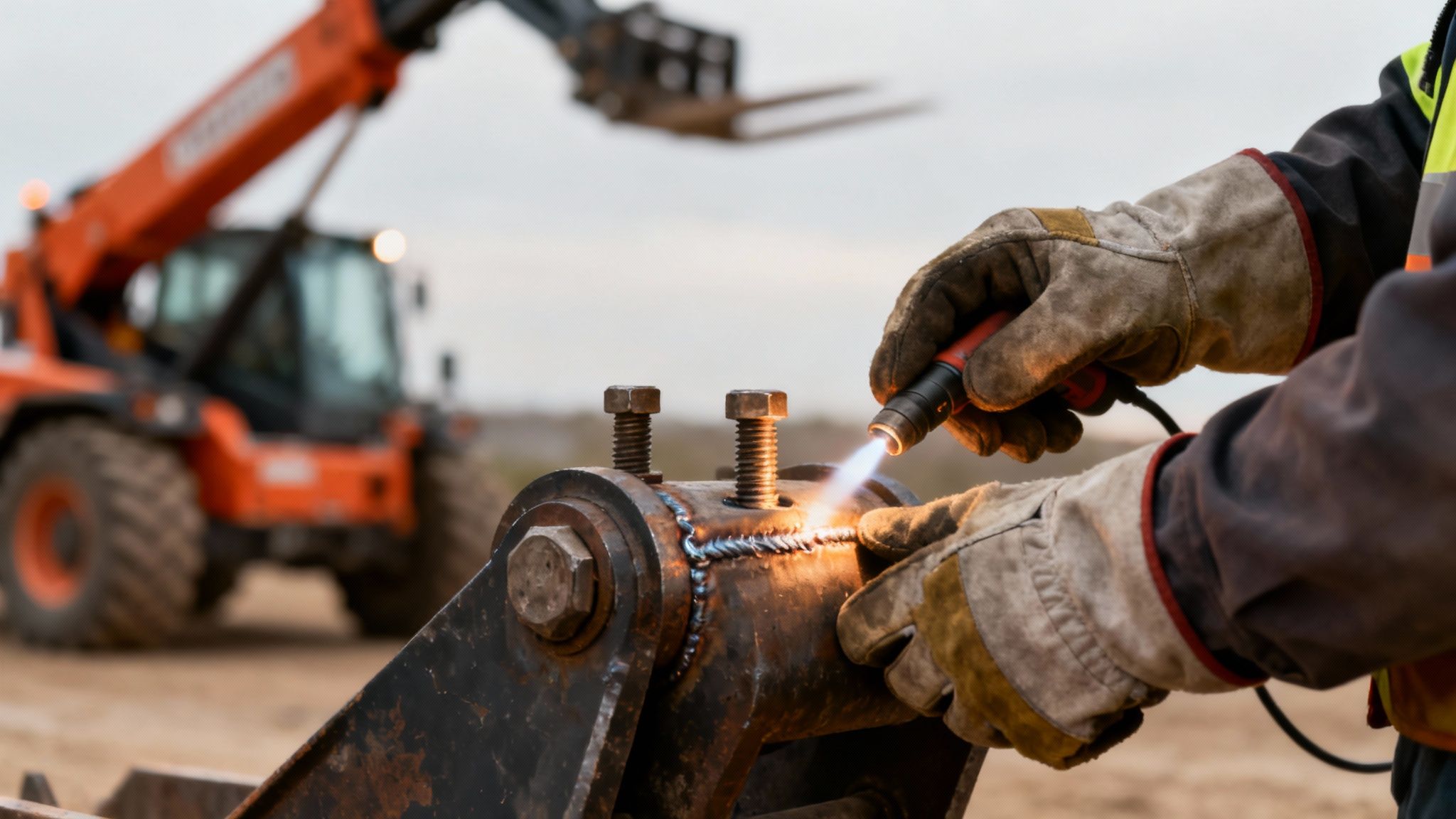
- Welds and Structure: Look closely at all welds for signs of stress, hairline cracks, or any distortion. Pay extra attention to high-stress points like the mounting plates and lifting eyes.
- Pins and Locking Mechanisms: Make sure all locking pins are present, straight, and fit snugly. The mechanism that locks the attachment to the carriage must be fully engaged and free from damage.
- Hydraulic Hoses: For powered attachments, check all hydraulic hoses. Look for leaks, bulges, cracks, or signs of abrasion. A burst hose means a sudden loss of control and a dangerous fluid spill.
- Moving Parts: On attachments like grapple buckets or winches, check that everything moves smoothly without any odd noises or stiffness.
These checks take minutes, but they are one of the most effective ways to prevent an accident.
A machine is only as safe as its weakest component. A damaged or improperly secured attachment compromises the entire lifting operation, regardless of the operator’s skill.
Always Consult the Load Chart
Every time you connect a different attachment, you change how the telehandler behaves. Each new tool has its own weight and centre of gravity, which directly affects the machine’s safe working limits. This is why you must always refer to the manufacturer’s load chart for that specific machine-and-attachment combination.
The chart isn’t a guideline; it’s a set of absolute limits. It tells you exactly how much you can safely lift at different boom extensions and angles. Ignoring it is a fast track to overloading the machine, which is a leading cause of tipping incidents.
Secure Connection and Disconnection Practices
The process of attaching and detaching these heavy tools demands focus. Rushing this step is a common mistake that can lead to an insecure connection.
Always stick to these best practices:
- Work on Level Ground: Only change attachments on a firm, level surface. This ensures the telehandler is stable throughout the process.
- Confirm Engagement: Once connected, operate the attachment gently just off the ground. Tilt and crowd it to double-check all locking pins are fully engaged and secure.
- Safe Disconnection: When taking an attachment off, lower it flat onto the ground or a stable stand. Make sure it’s in a safe, secure position before you disengage the locking pins.
Integrating these practices into wider fleet safety management strategies is a smart move that boosts overall site safety and efficiency.
Understanding UK Regulations Like LOLER
In the UK, lifting operations are governed by the Lifting Operations and Lifting Equipment Regulations 1998 (LOLER). These rules apply to any piece of kit used for lifting. This absolutely includes telehandlers and their attachments, especially those designed for lifting goods or people, like jibs, hooks, and man baskets.
Under LOLER, these attachments are classed as “lifting accessories” and must be thoroughly examined by a competent person at regular intervals. It’s your responsibility to make sure any equipment you hire is fully compliant and comes with the right certification.
Understanding your legal duties is crucial for running a safe, compliant site. For complex lifts, relying on professionally trained personnel is essential. You can learn more about the importance of using skilled machinery operators to ensure every job is done safely and efficiently.
Maintaining Attachments for Better Performance
Well-maintained attachments for telehandlers perform better, last longer, and are your best defence against unexpected downtime. Think of maintenance not as a chore, but as a small investment in reliability. A few simple habits can make a massive difference, ensuring the kit you’ve hired is always ready to earn its keep.
This proactive approach also builds a strong relationship with your plant hire provider. It shows you’re a professional operator who respects the machinery, which is always valued. Looking after the kit protects your project schedule and your reputation.
Daily Habits for Attachment Health
Effective maintenance starts with simple, daily checks that take just a few minutes. These are not complicated procedures, but they’re essential for spotting small issues before they become major problems.
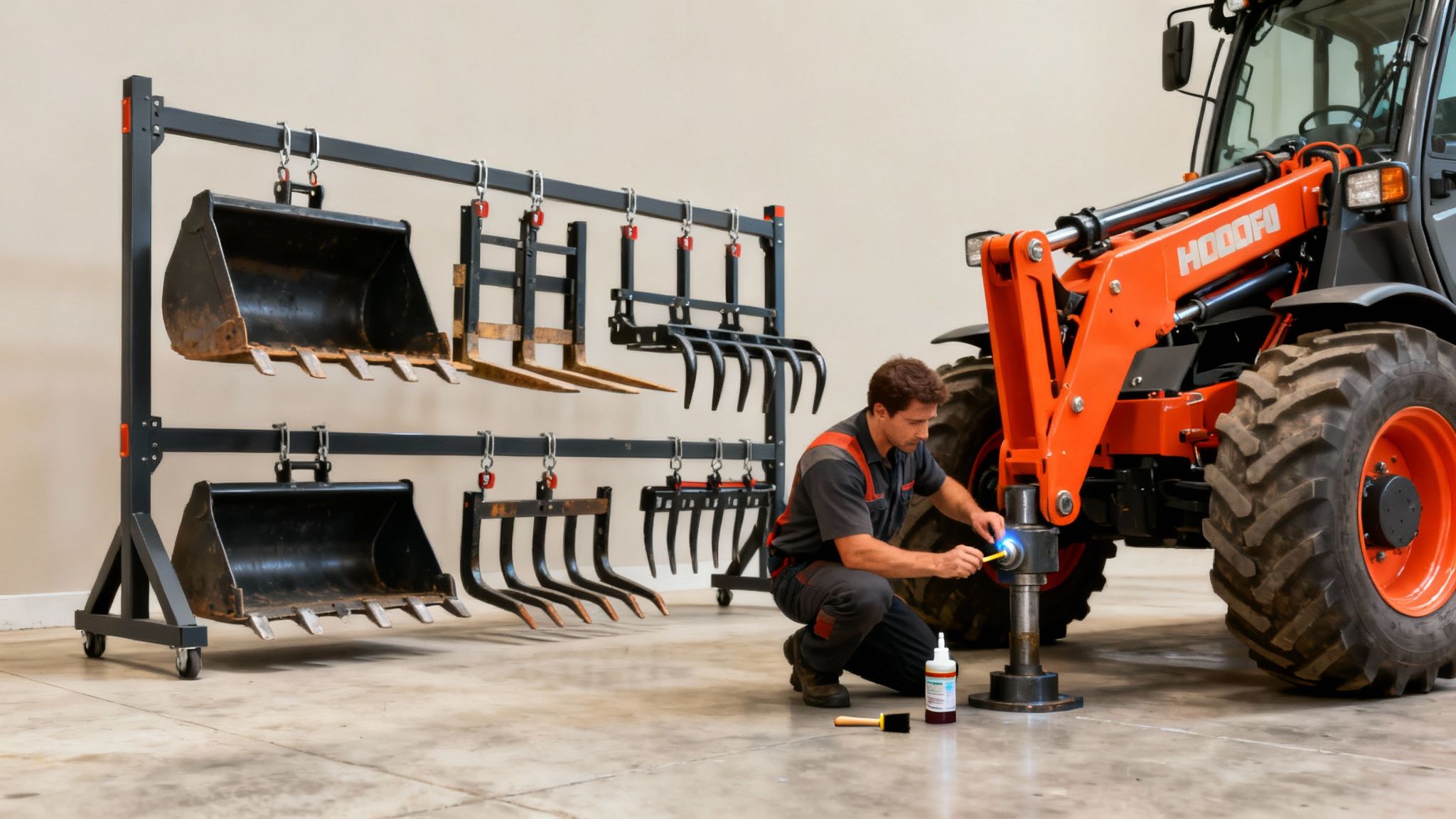
First, make cleaning a priority. At the end of each shift, take five minutes to clean off any mud, concrete, or debris from the attachment. This isn’t just about keeping things looking tidy. A clean attachment allows for a proper visual inspection, making it easier to spot wear or damage.
Next, grease all pivot points regularly. Any part that moves, like the hinge on a grapple bucket, needs lubrication to reduce friction and wear. Consistent greasing is a cheap and easy way to extend the life of any mechanical component.
Longer-Term Care and Storage
Beyond the daily routine, a little extra attention goes a long way. These longer-term checks are crucial for the structural integrity and safe operation of your attachments, especially those handling heavy loads or using hydraulic power.
Key Inspection Points:
- Check for Metal Fatigue: Pay close attention to the areas around welds and mounting points. Keep an eye out for any hairline cracks or signs of stress. These are indicators that the attachment may need a professional inspection or repair.
- Keep Hydraulics Clean: For powered attachments, the hydraulic connectors must be kept spotless. Wiping them clean before connecting stops dirt and grit from entering the system, which can cause serious damage.
- Store Attachments Correctly: When not in use, store attachments on a flat, stable surface. It’s best to place them on wooden blocks to keep them off the damp ground. This stops them from being damaged by other site traffic and protects them from corrosion.
Proper storage is an often-overlooked part of maintenance. An attachment left half-buried in mud is far more likely to corrode and fail prematurely than one stored securely.
By integrating these simple maintenance tasks into your site routines, you ensure that every attachment you use is safe, efficient, and ready to perform. This diligence prevents costly delays and shows a commitment to operational excellence.
Your Telehandler Hire Partner in Norfolk and Suffolk
As we’ve covered, a telehandler is only as good as the attachment you put on it. Getting that choice right, and using it safely, is what transforms a project. The takeaways are simple: know your machine’s capabilities, pick the right tool for the task, never skip safety checks, and stay on top of maintenance. It’s this combination that ensures you get real value from your hire.
Here at Aylsham Plant Solutions, we do more than just drop off plant and machinery. We provide the hands-on advice that contractors across Norfolk and Suffolk need to get the right equipment for the job. We’re a local, dependable partner, focused on helping you keep your projects moving forward safely and efficiently.
Our roots run deep in the region’s construction industry. This means we understand the real-world challenges you face on site. Whether you’re managing a large civil engineering scheme or a tight residential build, we have the right attachments for telehandlers and the practical knowledge to back them up.
The right partnership is just as important as the right equipment. Working with a local supplier who understands your site’s specific needs ensures you get responsive service and reliable machinery, every time.
Choosing a hire partner comes down to trust. We’re committed to providing modern, well-maintained equipment that won’t let you down. Our goal is to build genuine relationships that help power successful projects all across East Anglia.
Ready to talk about what your next project needs? Whether it’s a specific telehandler, a specialist attachment, or a complete groundwork solution, our team is ready to help. To see our full fleet, you can explore our range of plant hire options and find the perfect machine for your job. Give us a call today to get started.
Common Questions We Hear on Site
Even with the best plan, questions always pop up on the job. To help you make the right call, we’ve put together answers to some of the most common queries we get from contractors about telehandler attachments. Think of this as a quick-reference guide to keep things safe and efficient.
What’s the Most Common Attachment You See?
By a country mile, it’s the standard pallet fork. Its main job is lifting and moving palletised materials like bricks, timber, and supplies. This makes it the absolute workhorse on nearly every building site and farm. It’s the tool that defines the telehandler’s core purpose as a go-anywhere, rough-terrain forklift.
That said, the general-purpose bucket is a very close second. The ability to scoop up and move bulk materials like soil and aggregate makes it essential for groundwork and site clearance. On many jobs, it saves you the cost of bringing in a separate loading shovel.
Will Any Attachment Fit My Telehandler?
No, definitely not. Attachments and telehandlers are not universally compatible. The connection point, known as the carriage or headstock, often differs between manufacturers. While the JCB Q-Fit system is very common in the UK, other big names like Manitou and Merlo use their own unique designs.
It’s absolutely critical to make sure an attachment’s mounting plate is a perfect match for your telehandler’s carriage. A loose or incorrect fit is a massive safety risk and can lead to catastrophic failure during a lift.
Before you hire anything, always double-check compatibility with your plant hire provider. They’ll make sure the kit you get is a secure and correct match for your machine.
Do I Need a Special Ticket for Certain Attachments?
In the UK, the operator must be competent and properly trained for the specific telehandler and attachment they are using. A standard telehandler ticket covers a lot of ground, but some attachments fall under much stricter rules.
For example, using a man basket (also known as a MEWP attachment) is heavily regulated by LOLER (Lifting Operations and Lifting Equipment Regulations) and PUWER (Provision and Use of Work Equipment Regulations). This almost always means the operator needs specific training, like an IPAF qualification, on top of their standard telehandler ticket.
Always check the exact training and certification needed for the job you’re doing. A good plant hire company can give you clear guidance on the qualifications required to keep your site safe and fully compliant.
At Aylsham Plant Solutions, we do more than just supply machinery; we provide the practical expertise to make sure you have the right tools for the job. Contact our team to discuss your attachment needs and get a quote for your next project in Norfolk or Suffolk.
Related Posts